

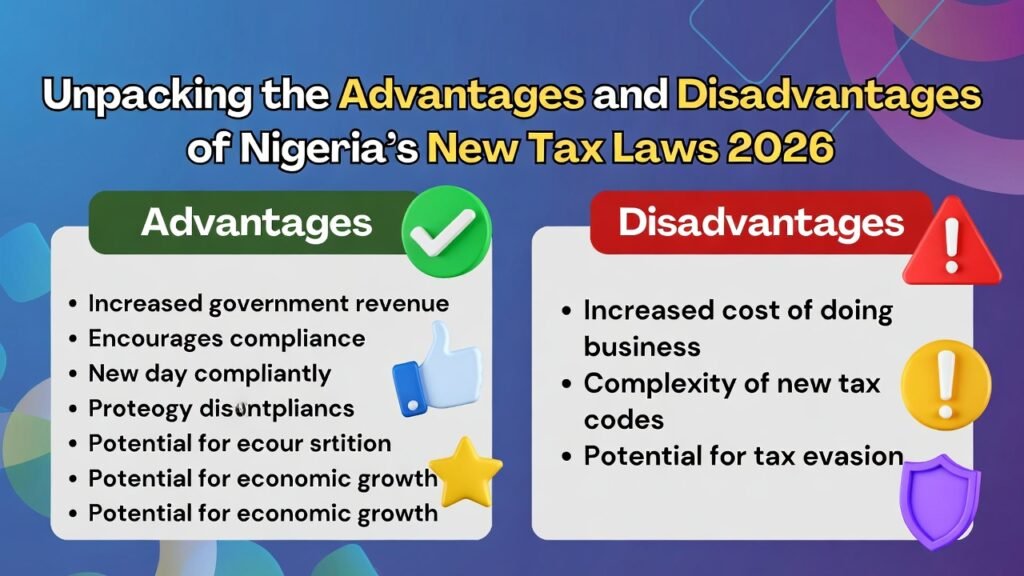
Unpacking the Advantages and Disadvantages of Nigeria’s New Tax Laws 2026
In 2026, Nigeria’s fiscal landscape is undergoing a significant transformation with the implementation of the new tax laws, primarily through the Nigeria Tax Act 2025. These reforms, spearheaded by the Presidential Committee on Fiscal Policy and Tax Reforms under Chairman Taiwo Oyedele, aim to simplify the tax system, boost economic growth, and ensure fairness. For small businesses struggling with compliance burdens and big corporations navigating complex regulations, these changes promise a mix of relief and opportunities. However, like any major overhaul, they come with challenges that could impact operations.
This article breaks down how the new tax laws 2026 benefit small and big businesses in Nigeria, drawing on expert insights, including direct quotes from Taiwo Oyedele. We’ll explore the advantages—such as tax exemptions and reduced rates—that foster growth, alongside disadvantages like potential compliance hurdles. By understanding these, entrepreneurs and executives can better position their ventures for success in a stabilizing economy. With inflation easing and GDP projections at 4.4%, these laws could be a catalyst for broader prosperity.
Background on Nigeria’s New Tax Laws 2026
Nigeria’s tax system has long been criticized for its complexity, with multiple overlapping taxes that stifled business growth. The new tax laws 2026 consolidate previous acts like the Companies Income Tax Act (CITA) and Personal Income Tax Act (PITA) into a unified framework under the Nigeria Tax Act 2025. Effective from January 2026, these reforms eliminate redundancies, harmonize rates, and introduce exemptions to encourage formalization.
Taiwo Oyedele, the architect behind these changes, has emphasized their pro-growth intent. In a media workshop in Lagos, he stated, “The reforms are not aimed at imposing heavier tax burdens on citizens but at rebuilding trust in Nigeria’s tax system through fairness, transparency, and accountability.” This shift moves away from aggressive revenue collection toward a system that supports economic expansion.
Key components include reduced Corporate Income Tax (CIT) rates, expanded Value Added Tax (VAT) exemptions, and streamlined administration. For small businesses—defined as those with turnover below N100 million—the laws offer zero CIT liability. Big businesses benefit from lower overall rates and incentives for investment. However, the transition requires adaptation, as old loopholes close.
These laws align with Nigeria’s broader economic goals, including increasing non-oil revenue to 30% of GDP by 2030. As Oyedele noted in a LinkedIn post, “Reduction of corporate income tax rate from 30% to 25% and harmonisation of earmarked taxes at a reduced rate” is designed to make Nigeria more competitive globally.
Advantages for Small Businesses
Small businesses, often in the informal sector, have historically borne disproportionate tax burdens. The new tax laws 2026 address this by providing substantial relief, allowing owners to reinvest savings into operations.
One major advantage is the exemption from Companies Income Tax (CIT) for firms with annual turnover below N100 million. This zero-rate policy means micro and small enterprises—comprising over 90% of Nigerian businesses—can operate without CIT deductions. Oyedele explained this in a Premium Times interview: “Firms with turnover below N100 million will pay zero CIT. You now have the motivation to formalise your business, because you have tax benefits rather than the disadvantages we used to see.”
This exemption frees up capital for hiring, inventory, or expansion. For instance, a Lagos-based retailer with N50 million turnover could save thousands in taxes, potentially adding staff or upgrading equipment. Additionally, small businesses enjoy exemptions from Capital Gains Tax (CGT), Withholding Tax, VAT on certain inputs, and the Development Levy.
Another benefit is simplified compliance. The laws introduce a single tax identification number and digital filing platforms, reducing paperwork. Oyedele highlighted this in BusinessDay: “Over 90% of Nigerians exempted from PAYE… for 97-98 per cent of Nigerians, they will either no longer pay PAYE, or they’ll pay less PAYE.” For small business owners employing low-wage workers, this lowers payroll costs.
VAT reforms add value too. Zero VAT on essentials like food, healthcare, and renewable energy reduces input costs. A small agro-processor, for example, saves on energy bills, improving margins. Oyedele noted in ThisDay: “Small businesses and informal operators should expect less tax pressure while they are small and more structured as they grow.”
Incentives for formalization are key. Previously, informal status avoided taxes but limited access to loans. Now, registering brings benefits like input VAT credits, encouraging growth. A study by PwC estimates this could formalize 20% more SMEs, boosting GDP by 1-2%.
Overall, these advantages empower small businesses to thrive. As Oyedele said in The Nation: “Under the new laws, individuals earning the national minimum wage or less will be exempt from Personal Income Tax (PIT),” extending relief to sole proprietors.
Advantages for Big Businesses
Large corporations in Nigeria, often in oil, manufacturing, or finance, face high compliance costs. The new tax laws 2026 offer streamlined processes and rate reductions to enhance competitiveness.
A headline benefit is the CIT rate cut from 30% to 25%. This saves millions for big firms, freeing funds for R&D or expansion. Oyedele described this in his LinkedIn article: “Reduction of corporate income tax rate from 30% to 25% and harmonisation of earmarked taxes at a reduced rate.” For a multinational like Dangote Group, this could mean substantial savings, reinvested in infrastructure.
Harmonization eliminates multiple taxes, reducing administrative burdens. Previously, firms dealt with over 60 taxes; now, it’s consolidated. This “coordinated administration architecture,” as Oyedele calls it in ThisDay, minimizes disputes and audits, saving time and legal fees.
Modern VAT rules allow full input credits, lowering production costs. Big exporters benefit from unilateral tax credits on foreign income, avoiding double taxation. Oyedele emphasized: “Unilateral tax credit for income taxes paid abroad to prevent double taxation.”
Incentives for investment are robust. Tax holidays for renewable energy and infrastructure projects attract FDI. For tech giants, deductions on AI and digital investments spur innovation. PwC forecasts this could increase corporate investments by 15%.
Big businesses also gain from a fairer system targeting wealthier entities. Oyedele told The Guardian: “New tax laws will target wealthy earners, not the poor.” This shifts burden from overtaxed sectors, promoting equity.
In summary, these laws make Nigeria attractive for big business. As Oyedele noted in GazetteNGR: “We have one of the highest tax burdens on businesses worldwide. We rank in the top ten,” but reforms aim to change that.
Disadvantages and Challenges for Small Businesses
While beneficial, the new tax laws 2026 aren’t without drawbacks for small businesses. Transitioning could pose initial hurdles.
One disadvantage is the learning curve. Simplified doesn’t mean simple; owners must understand new rules or face penalties. Oyedele acknowledged misunderstandings in a YouTube video: “The changes are being widely misunderstood.” Small firms without accountants might struggle with digital filing, leading to errors.
Formalization incentives could backfire if not managed. While exemptions apply, growing beyond N100 million triggers full taxation, potentially deterring expansion. A CableNG article notes concerns: “While it exempts individuals earning ₦800,000 or less annually from Personal Income Tax (PIT), this threshold should be increased to ₦1,200,000.”
VAT exemptions help, but not all inputs qualify, leaving gaps. Small importers might face higher costs if credits are delayed.
Compliance costs, though reduced, persist. Registration and audits require time, straining micro-enterprises. In rural areas, digital access is limited, exacerbating inequality.
Finally, enforcement risks: Overzealous officials could misapply laws, as seen in past reforms. Oyedele warned in interviews about building trust, implying potential teething issues.
Disadvantages and Challenges for Big Businesses
Big businesses face their own set of disadvantages under the new tax laws 2026, primarily around closed loopholes and increased scrutiny.
The harmonization closes tax avoidance avenues, potentially raising effective rates for some. Firms using offshore structures might pay more, as unilateral credits don’t cover all scenarios.
Administrative changes could cause short-term disruptions. Consolidated filing requires system overhauls, costing millions in IT upgrades. Oyedele noted in Premium Times: “Previous reforms created multiple taxes that burdened the informal sector,” but big firms adapted to those; change means re-adaptation.
Targeted at wealthy, laws introduce progressive elements. Higher earners in corporations face reduced PIT relief, affecting executive compensation.
Economic formalization pressures suppliers. Big firms must ensure small partners comply, adding supply chain complexity.
Lastly, if inflation persists, fixed thresholds (e.g., N100m for exemptions) erode quickly, indirectly raising taxes. Veriv forecasts suggest this risk in worst-case scenarios.
Balancing Advantages and Disadvantages: Expert Perspectives
Taiwo Oyedele has been vocal about the reforms’ balance. In ThisDay, he said: “The biggest win is for the economy as a whole. While ordinary citizens benefit from fairness and less pass-through costs, workers benefit from higher disposable income, and small businesses gain from higher exemption thresholds and simpler compliance.”
Advantages outweigh disadvantages for most, per experts. A table summarizes:
| Aspect | Small Businesses Advantages | Small Businesses Disadvantages | Big Businesses Advantages | Big Businesses Disadvantages |
| Tax Rates | Zero CIT below N100m | Growth triggers taxes | CIT reduced to 25% | Closed loopholes increase effective rates |
| Compliance | Simplified digital filing | Learning curve | Harmonized taxes | System overhauls costly |
| Exemptions | Multiple tax exemptions | Limited input coverage | Input VAT credits | Progressive PIT on executives |
| Incentives | Formalization benefits | Rural access issues | Investment deductions | Supply chain compliance |
Oyedele in BusinessDay: “From January 2026, you will feel the impact,” promising tangible gains.
Implementation and Future Outlook
Implementation starts January 2026, with FIRS overseeing. Training programs aim to ease transition. Oyedele stressed in GazetteNGR: “Low-income earners, who paid 96 per cent of income tax in the past, would now benefit from full tax exemption.”
Future: Reforms could raise revenue to N34 trillion, funding infrastructure. For businesses, adapting early is key—consult experts, digitize records.
Conclusion
The new tax laws 2026 offer a lifeline for small and big businesses in Nigeria, promoting growth through exemptions and reductions. As Taiwo Oyedele aptly put it, they rebuild trust and fairness. While disadvantages like compliance challenges exist, the net benefits—lower burdens, incentives—position Nigeria for economic resilience. Businesses should embrace these changes to thrive.
For more articles like this Visit